
By Anamoly Press Team • September 29, 2026
💡 Technical Review & Accuracy Check
Christopher Armstrong, Founder and Head of R&D, personally vets every scientific claim and compound specification for accuracy.
📌 Short Answer
To buy mountain bike shoes with grip, evaluate the complete system: compound friction, pedal-pin interface, tread geometry, sole stiffness, fit, and trail walkability. Balance secure power transfer and predictable foot placement with the toe room and durability your riding demands.
To buy mountain bike shoes with grip, start by treating pedal control as a system rather than a single outsole trait: rubber deforms against the pedal; tread meets the pins, and fit keeps your foot positioned while the bike moves underneath you. A shoe can feel sticky in a hand test yet lose useful contact when the tread, sole, or fit works against the pedal interface.
Start with the interface itself: the pedal and shoe have to work together before rubber chemistry or tread claims mean much on trail. From there, compare each part by the riding problem it solves and the tradeoff it introduces.
Test drive the Pin-Lock MTB risk-free
How to buy mountain bike shoes with grip: start with the interface.
If you want to buy mountain bike shoes with grip, do not reduce the decision to a rubber adjective. Grip is a system: the compound must create useful friction; the tread must meet the pedal; the chassis must control movement, and the fit must keep your foot positioned over the contact area. A shoe can feel sticky in your hand yet perform poorly if the pins cannot engage, the sole twists under load, or your foot shifts inside it.
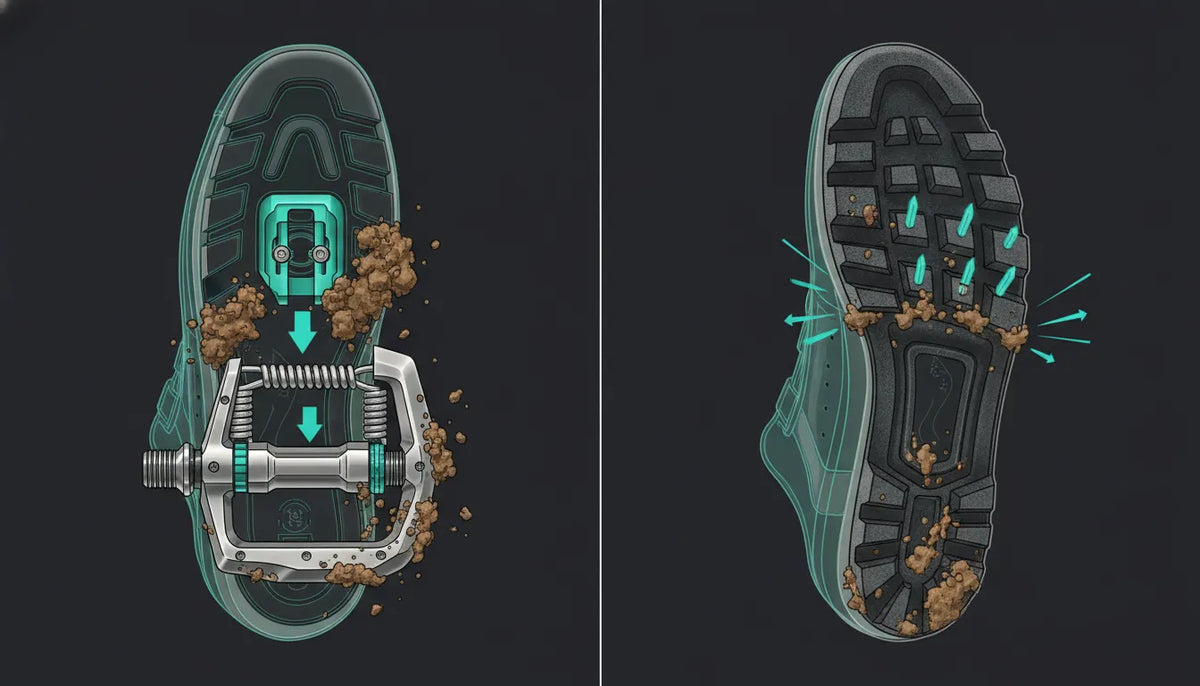
Start with the pedal-pin interface: ask how the outsole is shaped around the pins, whether the contact zones leave room for pin engagement, and whether the pattern stays predictable when your foot lands slightly off-axis. Here at Anamoly Labs, we position MTB-G around the pedal interface and the small corrections riders make to stay upright; that is a more useful buying lens than simply asking whether a product uses "sticky" rubber.
Then inspect the full underfoot system:
- Compound: Look for a clear explanation of the intended balance between friction, durability, and trail conditions. Grip that disappears quickly is not a complete performance win.
- Tread: Check whether the outsole has a defined pedal contact area, rather than treating every groove as equally important. The tread should support consistent pin engagement without creating an unstable platform.
- Chassis stiffness: Consider how much the sole and midsole resist unwanted twisting. You want enough structure to keep pressure directed through the pedal, without confusing rigid construction with automatic grip.
- Fit: Confirm heel hold, closure security, and adequate toe room. A wide toe box can support control when it holds the foot securely instead of allowing it to slide.
- Hike-a-bike use: Decide how often you will leave the pedals. Look for outsole zones and protection that make short trail sections manageable, while recognizing that a pedal shoe is still designed around riding.
Finally, look for evidence that the brand evaluates the system under realistic loads: useful documentation explains how rubber deforms across surfaces, how outsole edges may round off over time, and how the design manages slip or roll. For more context, read this guide to grippy mountain bike shoe science. Those details help you compare a complete interface rather than selecting a shoe from one headline material claim.
What makes a mountain bike shoe grip the pedal?
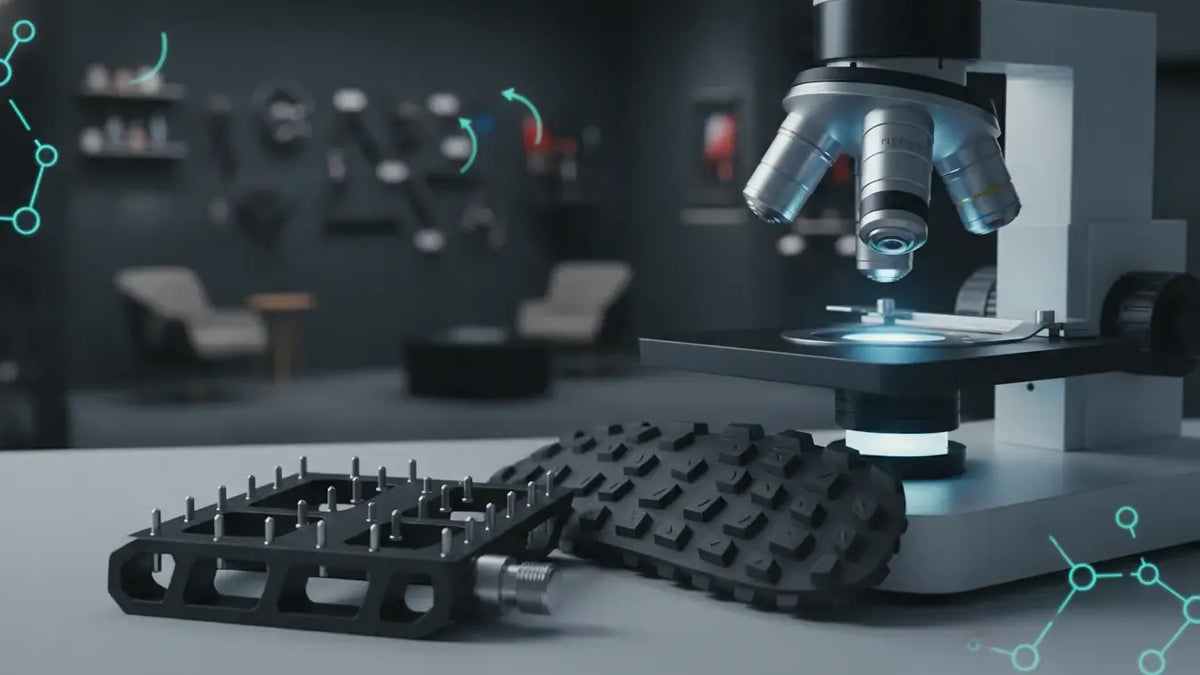
Flat-pedal grip starts with the rubber compound, but it does not end with a sensation of stickiness. At the pedal-pin interface, the outsole must deform around contact points, resist shear as the foot loads the pins, and keep behaving predictably when dust, moisture, or wear changes the contact. That is why a compound should be judged as part of a system, not as a standalone marketing adjective.
Academic rubber-friction research identifies two primary contributors: hysteresis and adhesion. Hysteresis comes from internal damping as an elastomer deforms under the opposing surface; a rougher surface or higher contact pressure can increase that deformation-related contribution. Adhesion comes from attractive forces between the contacting bodies, while frictional shear stress at the contact helps explain why a shoe can feel secure under a centered load yet move when the rider twists, brakes, or lands off-axis. Read the underlying elastomer analysis in this peer-reviewed rubber-friction study.
Contact conditions matter just as much as the base material. Lubricants and wear particles can change frictional shear stress, so water mixed with trail grit, mud, or rubber debris should not be treated as a minor detail. Sliding can also modify an elastomer's surface layer; the cited model relates that change to contact pressure, velocity, and sliding distance. In practical buying terms, ask how the outsole is expected to behave after repeated rides and contamination, not only how it feels on a clean shop floor.
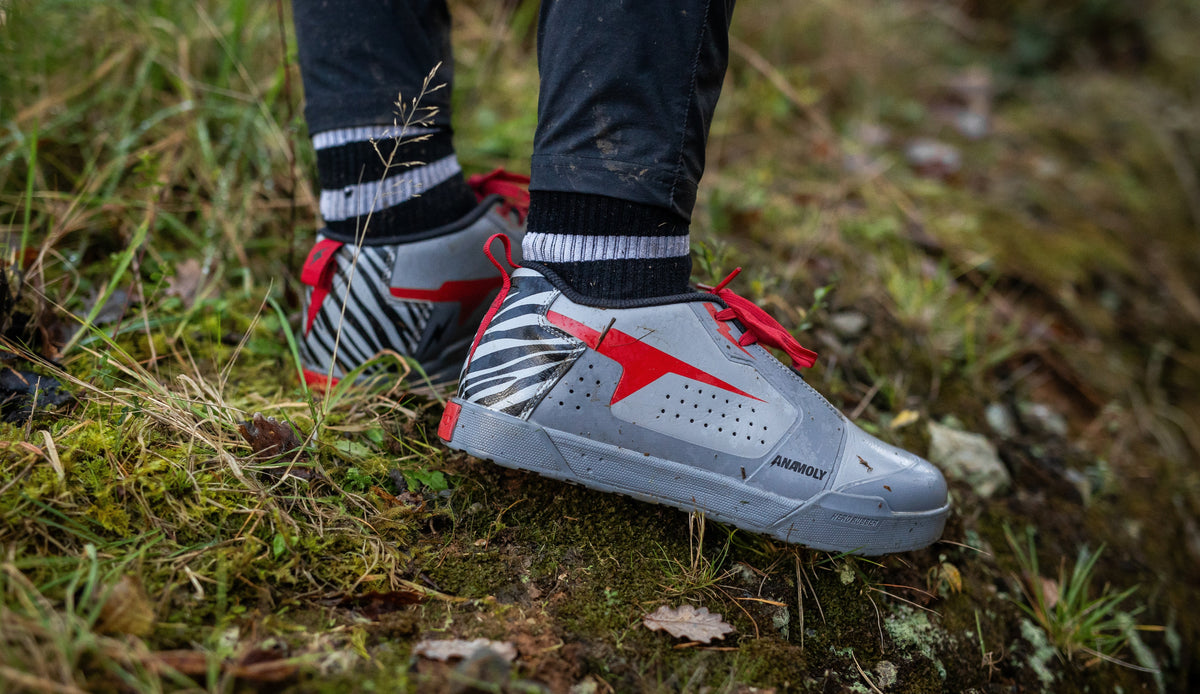
Our Pin-Lock MTB Shoe uses Hero Rubber™ MTB-G; here at Anamoly Labs, we describe it as a high-friction compound with strong dry-weather grip and a design intended to stay durable as it wears. Those are our attributed product claims, not conclusions that apply to every mountain bike shoe or a substitute for independent testing. Evaluate them alongside the pedal interface, outsole shape, sole stiffness, fit, and the conditions you ride.
Compound feel also should not be confused with frictional certainty: a soft or low-rebound rubber may change pedal feel, but it cannot guarantee that a foot will stay planted in every condition. Pin engagement, outsole shape, sole stiffness, fit, and rider technique still govern the result.
Use "sticky" as a starting question, not a buying conclusion. Check whether the maker explains wet contamination, wear, and the pedal interface; then inspect the full construction. For a product-specific example, review our Pin-Lock MTB Shoe alongside the rest of this guide's criteria.
How should tread geometry and sole stiffness work together?
Compound is only one part of a flat-pedal connection: tread geometry determines how the outsole presents that compound to pedal pins, while the sole and chassis determine how consistently your foot loads the contact patch. The practical goal is not maximum softness or maximum stiffness; it is a stable interface that holds during braking, cornering, and off-axis landings without creating a vague rolling sensation.
Start with the surface: a footwear study using the same rubber compound found that soling roughness was a major factor in friction on water-lubricated floors, and floor roughness also changed the result. That is useful direction, not a trail-performance guarantee; wet coefficient-of-friction numbers are difficult to interpret without roughness measurements and wear context. As the footwear sole roughness study explains, the outsole and opposing surface must be considered together.
Then inspect the tread architecture. Fluid channels can help disperse water and contaminants, because a continuous fluid film can reduce friction through hydrodynamic effects. In a separate controlled experiment, custom tread patterns with grooves perpendicular or oblique to the slide direction produced more dynamic friction than parallel grooves. Wider grooves also performed better in that test. The result supports looking for deliberate pin contact, drainage, and directional support, not simply counting lugs. However, the researchers used custom-built outsoles. Their findings do not directly rank complex commercial MTB outsoles, where compound, lug shape, spacing, deformation, wear, and pedal-pin geometry interact. Read the custom tread-pattern study as a design framework, not a commercial shoe guarantee.
| Factor | What to evaluate |
|---|---|
| Compound | Whether the rubber balances deformation, durability, and consistent contact under the conditions you ride. |
| Tread geometry | Pin engagement, usable contact area, drainage paths, lug direction, and how edges may round off with wear. |
| Sole/chassis stiffness | Whether the platform resists unwanted flex and torsion while still supporting controlled pressure through the pedal. |
| Buyer check | Ask how the brand tested friction, abrasion, and torsion, then match the design to your pins, terrain, and walking needs. |
When comparing shoes, look for a tread that lets the pins seat without excessive movement and a chassis that keeps that contact predictable. A balanced system should feel planted on the pedal while preserving enough underfoot comfort for the sections between trail features. No single material specification proves grip on its own.
Does fit change how much grip you can use?
A shoe can have capable rubber and still feel unreliable if your foot moves inside it: fit determines whether the pressure you create reaches the pedal in a repeatable way, and it changes how comfortably you can maintain that position over a long ride. Check heel lockdown, closure security, and toe room together rather than choosing a size from length alone.
A wide toe box gives the forefoot room without requiring the rest of the shoe to be loose. The goal is a stable heel and midfoot with enough room at the toes to avoid pressure that changes your stance. If the upper compresses the forefoot, you may compensate by shifting your foot or loosening the closure; either can reduce consistency at the pedal-pin interface. For more detail, read this guide to mountain bike shoe fit and toe room.
Fit guidance should be treated as product-specific: compare the current size chart with your measurements, then confirm heel hold, closure security, and toe room in the actual shoe rather than applying one sizing rule to every MTB model.
Finally, test the fit with the closure secured and your heel properly seated; you should be able to load the pedal without your foot sliding forward, while the toe room remains comfortable whether you are standing, descending, or walking. A roomy fit is beneficial only if the heel and midfoot remain secure: extra volume without proper lockdown can create the same vague contact as a soft or poorly matched outsole.
Are grippy MTB shoes walkable on trail?
Walkability matters when a ride includes hike-a-bike, creek crossings, trail access, or short sections where pedaling is not practical. A flat-pedal shoe can support these transitions, but it should still be judged first as cycling footwear. The right question is not whether it feels like a hiking shoe; it is whether its outsole and chassis provide enough walking traction without compromising the pedal interface.
Look for a sole that separates or combines useful zones for pedal contact and walking traction. The pedal area needs predictable pin engagement, while the heel and toe need enough tread to support steps on dirt, roots, and wet transitions; those features can improve short hike-a-bike sections, but they do not make a cycling shoe a substitute for dedicated hiking footwear.
Protection is part of the walking decision too: a reinforced toe area can matter when a rider catches a rock or makes an awkward dab, although that feature should be verified against the current product specifications rather than assumed from a generic MTB-shoe description.
For a deeper look at this tradeoff, read the guide to MTB shoe walkability and trail grip; if your route includes minutes of walking, prioritize outsole coverage, flex that supports a controlled step, and protection; if walking is incidental, prioritize the pedal interface and choose walking features that do not introduce unwanted movement on the pins.
A practical checklist before you buy mountain bike shoes with grip.
Use this sequence before you buy: start at the rubber, then inspect how the outsole meets pedal pins. Assess how the tread manages movement and how the chassis keeps your foot positioned. Only after those questions should fit, durability, and walking comfort decide between otherwise similar flat-pedal shoes. Here at Anamoly Labs, we position our Pin-Lock as a flat-pedal mountain bike shoe built around the interaction of width, grip, durability, weight, and all-day comfort.
- Compound: Confirm whether the rubber is designed for both dry and wet conditions, not just described as sticky. We present our Hero Rubber™, or MTB-G compound, as high-friction rubber that grips hard when dry and is designed to become stickier when wet. Treat that as our product claim, then consider the surfaces you actually ride.
- Pedal-pin contact: Look for evidence that the shoe was designed around the pedal interface. Ask whether the sole can conform around pins without feeling vague or allowing unwanted foot movement. We developed our MTB-G compound with pedal pins, off-axis landings, and constant micro-adjustments in mind; that is more useful than a generic grip label.
- Tread geometry: Inspect the layout, edge shape, and spacing around the main pedal zone. The tread should provide a predictable contact patch while still clearing mud and supporting repositioning. For wet-weather priorities, review this mountain bike shoe grip in wet weather discussion; do not assume a deep hiking lug automatically improves pedal control.
- Sole and chassis stiffness: Ask how the shoe transfers force without making walking awkward. A stiff-feeling shoe can improve stability, but stiffness alone does not prove grip; look for a clear explanation of how the chassis supports a predictable pedal interface.
- Fit: Check heel lockdown, closure security, and toe room while standing and pedaling. A cramped forefoot can change how consistently you load the pedal, so compare your measurements with the current size chart and use this guide to assess mountain bike shoe fit and toe room.
- Durability: Look beyond a soft compound's first-ride feel. Ask how the rubber, tread edges, toe area, and upper handle repeated pin loading, rock strikes, and abrasion; prioritize evidence about wear rather than an unqualified durability promise.
- Walking use: Decide how much hike-a-bike your routes include. A combined pedal and walking zone can support short climbs, wet transitions, and trail access, but it does not make a flat-pedal shoe a dedicated hiking shoe; weigh that versatility against your actual time off the pedals.
Test drive the Pin-Lock MTB risk-free
FAQ: Buying Mountain Bike Shoes With Grip.
What makes a mountain bike shoe grippy?
Grip comes from the interaction of the rubber compound, pedal pins, outsole geometry, and fit. A high-friction compound can deform around contact points, while tread features help the sole engage the pins and manage surface conditions. A secure fit also matters: if the foot moves inside the shoe, the rider cannot use the available pedal grip consistently.
What shoes should you wear when mountain biking?
For flat pedals, wear purpose-built flat-pedal mountain bike shoes with a grippy outsole, a stable chassis, and enough protection for trail impacts. Choose fit and toe room carefully, then match the tread and compound to your conditions. Clipless pedals require shoes designed for their cleat system, so flat-pedal shoes are not a substitute for cleated footwear.
Can mountain bike shoes be used for walking?
Yes, many flat-pedal mountain bike shoes can handle short walks and hike-a-bike sections. Look for an outsole that combines pedal contact with walking traction, rather than a design focused only on a smooth pedal zone. They are still cycling shoes, not dedicated hiking footwear, so comfort, flexibility, and traction may differ on long or technical walks.
Can mountain bike shoes be used for road cycling?
Yes, flat-pedal mountain bike shoes can be used for road cycling when the bicycle has flat pedals. Their grip, protection, and stable platform can suit riders who value control and occasional walking. They may feel less streamlined than road-specific shoes, and they are not intended for road bikes that use clipless pedals unless they support the required cleat system.
Sources & Scientific Citations
- Elastomer friction mechanisms and surface conditions, Tribology and Interface Engineering research.
- Footwear sole roughness and coefficient of friction, footwear traction research.
- Shoe tread parameters, fluid channels, and traction, footwear tread research.
- Sole hardness and slip-related outcomes, footwear safety research.
About the Author
The Anamoly Press Team brings you in-depth gear coverage rooted in real-world testing and engineering insight. Every article is reviewed by our Head of R&D for technical accuracy.
Ready to Test Your Grip in Real Terrain and Riding Conditions?
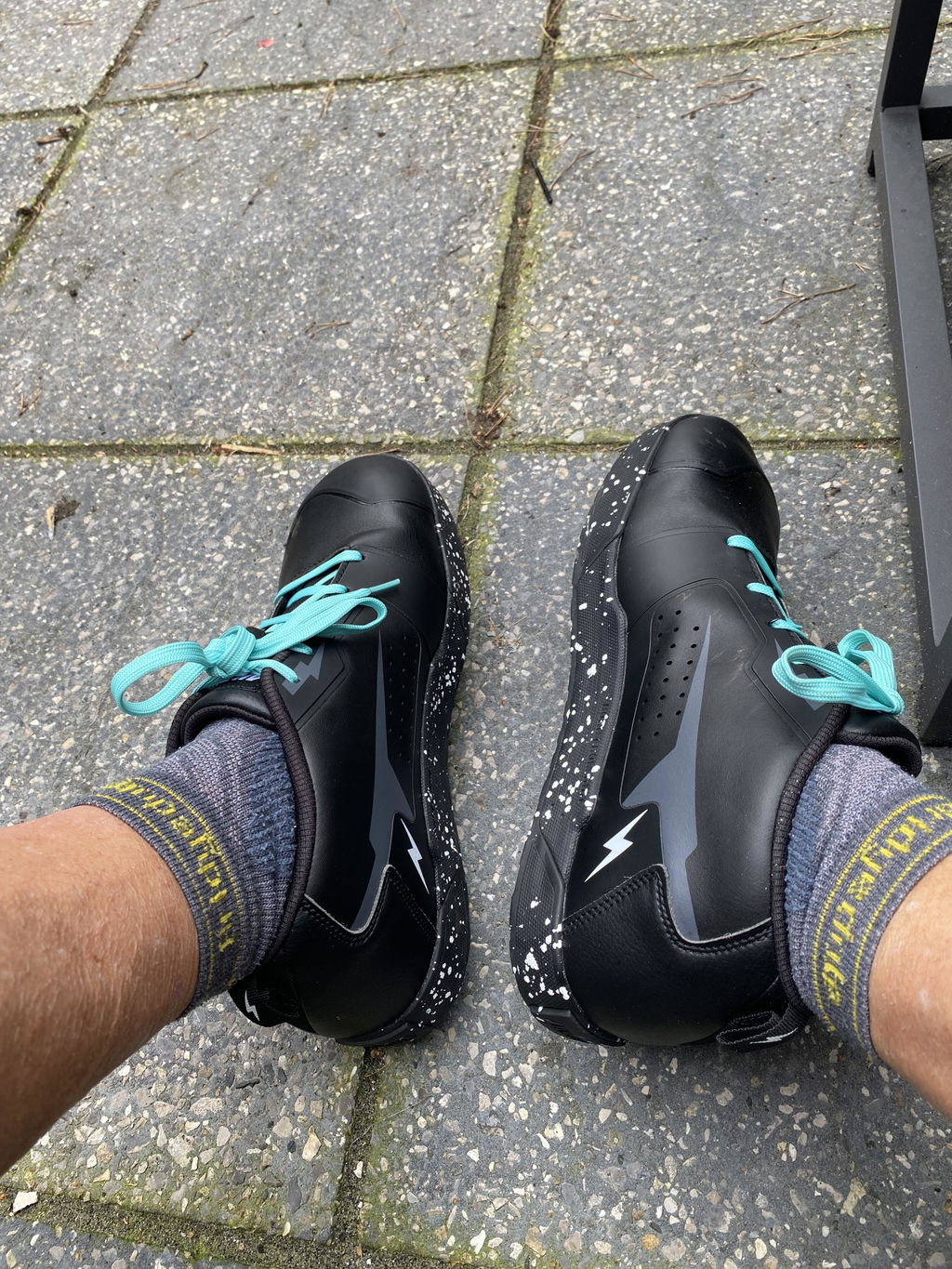
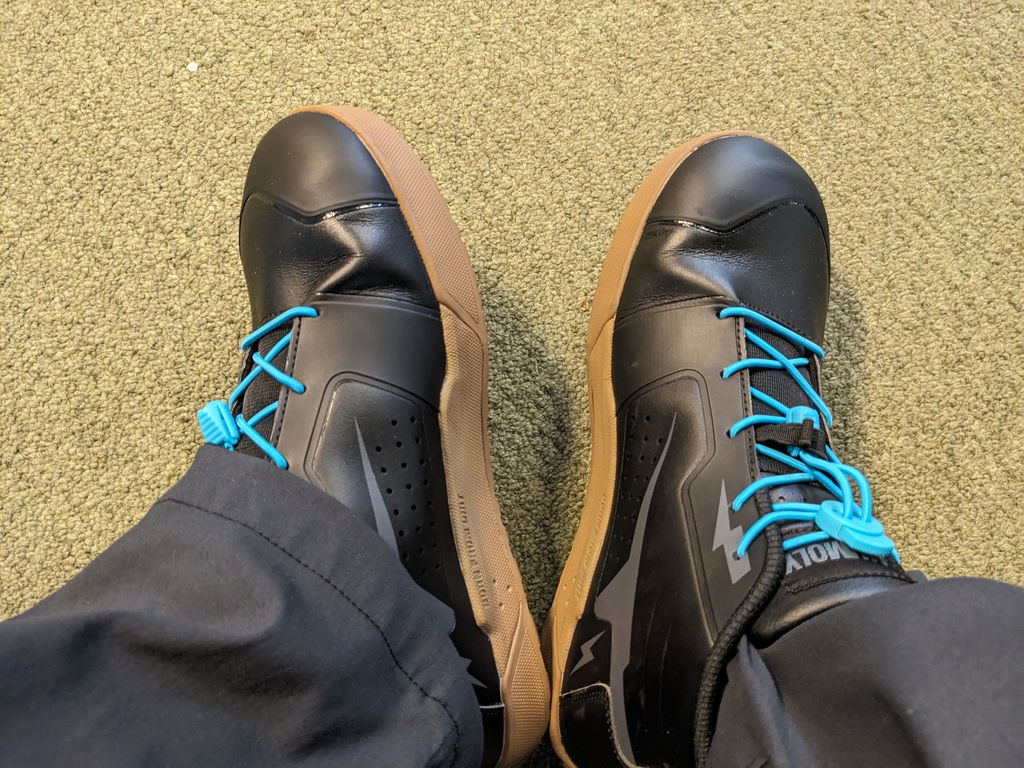
When a trail turns into a mix of water, mud, and changing grip, your shoes should help you stay connected to the pedals without forcing a tradeoff between control and comfort. The Pin-Lock MTB Shoe combines a traction-focused outsole with a wide toe box, giving your feet useful toe room while the supportive wrap keeps the shoe secure through demanding pedal strokes. Its compound and lug design are built to support dependable grip when the trail surface is lubricated, packed, or inconsistent; that is the kind of traction confidence a mud-ready shoe should provide across changing sections of the same ride.
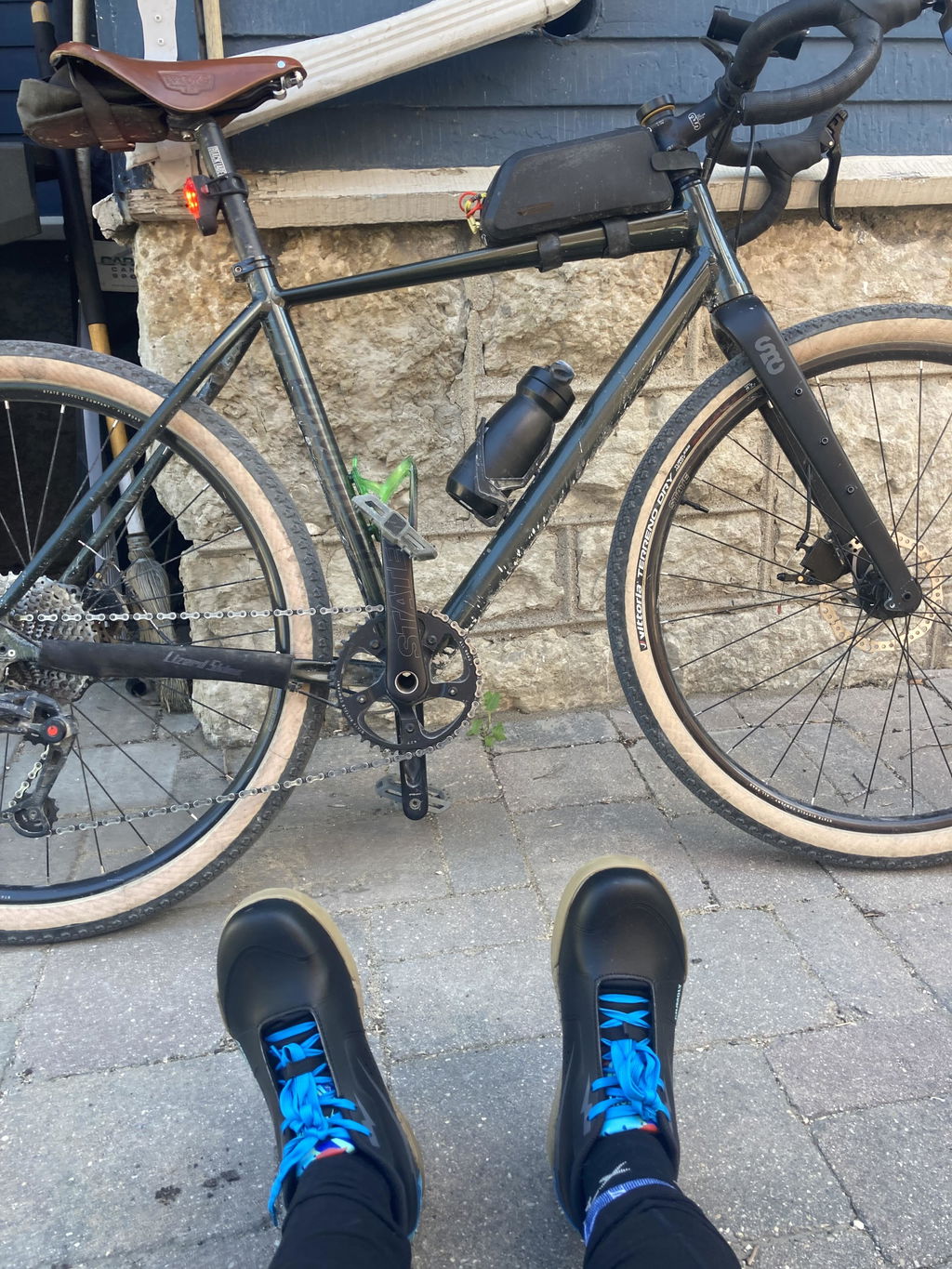
Every pair of Pin-Lock MTB Shoes is backed by our 30-Day Trail/Court Test Guarantee: order your size, ride them on your own flat pedals, test the Pin-Lock sole interface on real mountain bike terrain, and feel the difference in grip, support, and forefoot comfort. If they do not deliver the fit, traction, and control you need, return them within 30 days for a hassle-free exchange or refund.

Leave a comment
This site is protected by hCaptcha and the hCaptcha Privacy Policy and Terms of Service apply.