

By Anamoly Press Team • October 4, 2026
💡 Technical Review & Accuracy Check by Christopher Armstrong, Founder & Head of R&D
Our team researches and writes the gear guides you love, but every scientific claim and compound specification is personally vetted by our lead engineer to ensure absolute accuracy.
📌 Short Answer
Leather can resist rain, but leather alone does not make an MTB shoe waterproof. Water protection depends on treatment, seams, tongue, collar, lining, ventilation, drainage, and exposure time. For wet riding, a highly waterproof synthetic PU upper with an engineered polyester barrier liner can outperform leather alone by limiting water and dirt entry without giving up a supple, leather-like feel.
Leather can shed rain and trail spray, but an MTB shoe is not waterproof simply because its upper is leather. The result depends on how the hide is treated, how the shoe is assembled, and where water can enter during a ride.
So, are leather MTB shoes waterproof? Some can provide strong water resistance when the leather, coating, seams, tongue, collar, and lining are designed as one system—but none should be treated as permanently waterproof without limits. Research on leather waterproofing also evaluates treatment durability under flexing, which matters on every pedal stroke: wet performance is a construction and maintenance question, not a material label.
That distinction becomes clearer when you examine the leather and its surface treatment first. Then trace the weak points that decide whether a damp ride stays manageable or becomes a cold, saturated one.
Test drive the Pin-Lock MTB risk-free
Are leather MTB shoes waterproof, or only water resistant?
Leather MTB shoes can be highly water resistant, but leather alone does not make a shoe waterproof. The practical answer depends on the material treatment and the complete shoe construction. A treated leather upper may shed rain and trail spray for a useful period. That does not mean the shoe will keep feet dry during prolonged exposure, deep puddles, or immersion above the collar.
Leather is a material system, not a single waterproof specification. Its fiber structure, tanning process, finish, and added treatment all affect how readily water wets the surface and moves through it. Research on waterproof leather describes treatments designed specifically to improve water behavior, including polymer nanoemulsions used as waterproof fatliquors for chrome-tanned leather: one study examined both water repellency and flex durability. That distinction matters for MTB footwear because an upper must keep working while repeatedly flexing around the forefoot.
Surface behavior can be impressive without equaling a sealed shoe. In the same study, tested treatments produced contact angles above 148 degrees, indicating strong water repellency on the evaluated leather samples. The result describes a treatment and test condition, not a universal promise for every leather shoe in every ride. Other research has examined organosilicon plasma nanocoatings on crust leather for water-repellent footwear, as well as hydrophobic coatings made through low-pressure plasma polymerization. These approaches reinforce the point that waterproof performance is created through material and process choices, not assumed from the word leather alone.
The main failure points are usually where the upper meets the rest of the shoe. Water can enter through an untreated or exposed collar, the tongue opening, unsealed seams, perforations, or a lining that becomes saturated. A shoe can therefore have a water-repellent leather upper while still offering only weather protection. Conversely, a construction marketed as waterproof may perform better because it combines a protective upper with a liner, an extended collar, and carefully managed seams. Those details should be treated as part of the claim, not as optional accessories.
Exposure duration is the final calibration. Rain and splash resistance may be enough for wet grass or brief crossings; repeated spray, standing water, and immersion test the collar, tongue, seams, and internal volume rather than the leather surface alone. When comparing shoes, look for specific evidence about treatments and construction, then separate upper protection from outsole traction. Dry feet can improve comfort, but they do not tell you how securely the shoe will hold a pedal on a wet trail.
Which leather and coating details control water protection?
Leather is not a single waterproofing specification. A full-grain label describes the material category, but it does not tell you how the hide was tanned, lubricated, finished, or sealed. Those process decisions control how readily water wets the surface and how quickly it can move through the material. Research on waterproof leather makes the same distinction: performance depends on treatment rather than leather alone. One study on waterproof leather treatments describes growing demand for waterproof leather and the development of waterproof fatliquors.
Fatliquors are oils or related lubricating treatments introduced during leather processing. They help manage the material's feel, flexibility, and interaction with water. A waterproof fatliquor is therefore a manufacturing treatment, not a claim that every untreated leather upper will repel rain. In the cited study, researchers tested polymer nanoemulsions containing carboxyl groups as waterproof fatliquors for chrome-tanned leather. That is useful context when evaluating the question, are leather MTB shoes waterproof: ask what treatment was applied and how it was validated, rather than assuming the answer from the word leather.
Surface coatings provide another layer of control. Hydrophobic coatings are designed to reduce water spreading across the surface. Leather footwear research has examined both organosilicon-based plasma nanocoatings on crust leather and low-pressure plasma polymerization for hydrophobic footwear coatings. These are researched approaches, not proof that a particular retail shoe uses them. A product description should identify its actual coating or treatment before you infer performance from the science.
One technical measurement is contact angle: the angle formed where a water droplet meets the surface. A higher angle generally indicates that the droplet spreads less readily. In the polymer-treatment study, tested leather reached contact angles of 148.4 and 150.3 degrees, both higher than a conventional fatliquor. That result demonstrates the effect of a tested formulation under study conditions. It does not establish that the leather will remain waterproof during a ride, at a flexing crease, or after abrasion.
Flex durability is the practical check. A coating that repels droplets when new still has to tolerate thousands of bends without cracking, separating, or opening a path for water. The same study evaluated this issue using Maeser flex testing, reporting 13,928 and 19,492 flexes for two treated leathers at a 5 percent dosage. Laboratory flex results cannot be converted directly into trail life, but they show why credible water protection should be assessed alongside movement and wear. Look for treatment details, flex testing, and complete construction information; no single leather grade or coating guarantees waterproofing by itself.
Where do water-resistant MTB shoes usually leak?
Water usually enters a riding shoe at the transitions between materials, not through the middle of an intact upper. A leather panel can shed rain while the shoe still lets water through a stitched seam, an open collar, or the tongue area. That is why a product description that says splash-proof or water-repellent should not be read as protection against every wet-trail scenario.
Stitching and panel joins
Every needle hole creates a potential path through the upper. Thread can also wick moisture along the seam, especially where panels flex repeatedly over the forefoot. Seam placement, reinforcement, and any sealing treatment therefore matter as much as the leather itself. This is the mechanical reason stitchless or thermo-welded construction can reduce one common ingress route: it avoids the needle holes created by conventional stitching.
The tongue and collar opening
The collar is the largest opening in the shoe, so water running down a rider's ankle can enter even when the side panels remain relatively dry. A low collar, a loosely closing tongue, or gaps around the lacing system can turn steady rain into wet socks. An extended ankle collar and a waterproof liner are examples of design choices used to improve weather protection. But their presence does not make a shoe immune to water from above. One independent review described a lined, extended-collar design as offering reasonable weather protection, not unlimited protection: the construction details and wording are worth separating.
Lining, ventilation, and drainage
Once water passes the upper, an absorbent lining can hold moisture against the foot and slow drying. A shoe may also use ventilation openings for heat and sweat management; those openings can become entry points when spray or persistent rain reaches them. Drainage works in the opposite direction by helping water escape, but it cannot stop water entering from above. The tradeoff is practical: more airflow and easier drainage may improve comfort after a splash, while a more enclosed construction may resist direct exposure better.
Exposure time changes the outcome
A brief splash, damp grass, and hours of rain are different tests. Saturated materials, repeated flexing, and standing water give moisture more opportunities to cross a weak point. Some footwear also takes a long time to dry after a wet ride. Which means the next outing may begin with a damp lining rather than a dry interior. Inspect the shoe before trusting its water protection:
- Seams: Look for opened stitches, lifting overlays, or cracked sealant at flex points.
- Tongue and collar: Check whether the closure leaves a visible gap or channels water toward the foot.
- Ventilation: Identify openings that face upward or sit in direct splash zones.
- Interior: Check whether the lining stays damp after the exterior feels dry.
- Drainage: Confirm that water has a clear exit rather than pooling inside the shoe.
How should wet-trail traction change your shoe decision?
Dry feet and a secure foot on the pedal are separate problems. An upper can shed rain while the outsole still slides on a wet root. Or a shoe can grip the pedal well while allowing water through its collar during a long storm. Evaluate both systems before deciding whether a leather MTB shoe suits your riding.
Compound and tread determine contact with the trail
Rubber compound is the material variable to investigate first. Softer, higher-friction rubber can conform to small irregularities in rock and wood, while tread geometry determines how that rubber clears mud and contacts the surface. Published MTB footwear testing distinguishes between outsole compounds and lug patterns. Reinforcing that "rubber outsole" alone does not explain wet performance: the compound and its interface with the terrain matter.
On wet rock, the useful question is not whether the upper is leather. Ask whether the outsole maintains friction when a dab lands on a polished, rain-darkened surface. On roots, tread edges and rubber compliance help manage the changing contact points. In mud, spacing and shape influence whether the tread packs up or continues to expose usable rubber. These details matter most when the trail is slick enough that a short slip becomes a missed line or an uncontrolled foot plant.
Flat pedals add a second wet-grip test
Flat-pedal riders also need consistent contact between the outsole and metal pins. The tread must give the pins somewhere to engage without creating a rolling or vague sensation under load. A shoe that feels secure on dry dirt may behave differently when moisture reduces surface friction, especially during braking, cornering, or a rough descent.
Anamoly Labs uses Hero Rubber™ (MTB-G compound), a high-friction compound that becomes stickier when wet. Its DualTraction Pedal + Hike Grid is intended to address both pedal contact and walking traction, while the Diamondstok tread pattern is designed to interlock with metal pedal pins. Those are outsole and interface claims—they should not be confused with a claim that the upper is leather or completely waterproof.
Do not ignore hike-a-bike conditions
After rain, the shoe may spend as much time on slick rock, roots, and muddy trail as it does on the pedals. Hike-a-bike traction should therefore be part of the buying decision, not an afterthought. Look for a sole that remains predictable when your weight moves over the midfoot and toe. Then consider whether the tread sheds mud rather than carrying a smooth layer of it into the next step.
For a deeper explanation of how compound behavior affects wet riding, see our guide to wet-weather MTB shoe grip. The practical takeaway is simple: choose upper protection for the water exposure you expect, then verify compound, tread, pedal-pin contact, and walking traction independently.
What does the Pin-Lock MTB Shoe claim about wet conditions?
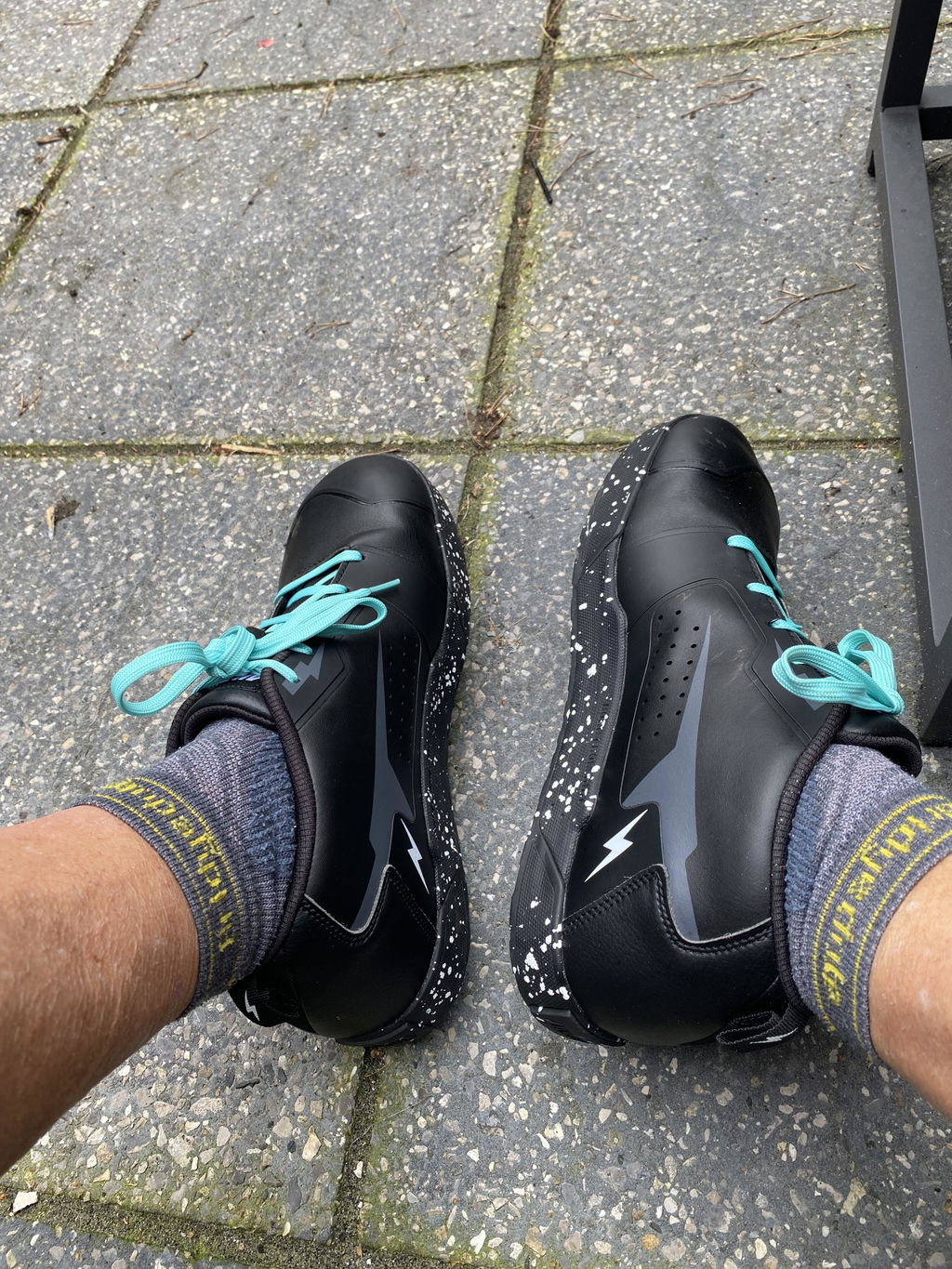
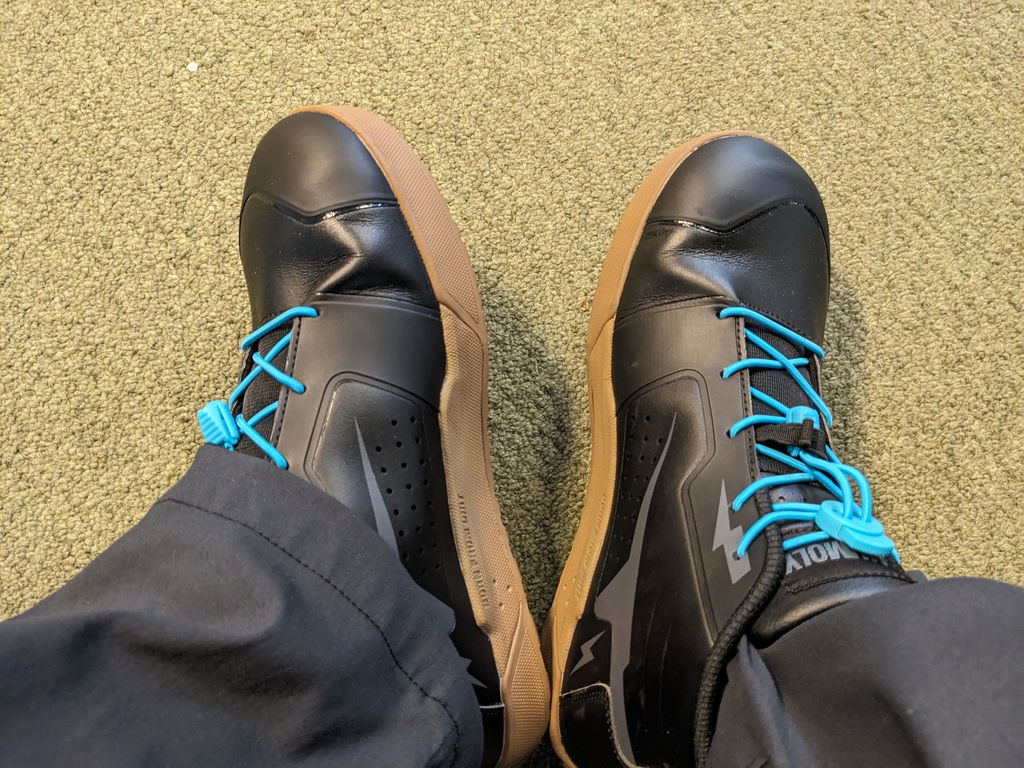
The Pin-Lock MTB Shoe makes a product-specific claim about wet-weather protection—and it is important to state the material distinction clearly: the upper is not leather. Anamoly Labs uses a highly waterproof synthetic PU (polyurethane) material derived from plastic, engineered to deliver a supple feel and leather-like texture and appearance without leather's tendency to absorb water, swell, and require conditioning. For wet riding, this PU construction is a more reliable waterproofing choice than leather alone; it delivers the appeal of leather without the drawbacks.
Water protection through thermo-welded construction
The product listing identifies waterproof construction and a thermo-welded, stitchless design. Anamoly Labs also adds strategically placed perforations for airflow and an engineered polyester barrier liner that prevents water and dirt from entering by design. Thermo-welding joins material layers without the needle holes created by conventional stitching; paired with the PU upper and barrier liner, it reduces potential routes for mud and water to enter during a wet ride.
The same construction is described as helping resist mud and water, while a reinforced thermo-welded and 3D heat-molded toe cap adds protection against rock strikes and awkward dabs. These details support a practical wet-trail claim: the shoe is designed to protect the foot and manage exposure better than a minimally constructed upper. They do not prove that the shoe remains dry during prolonged immersion, water entering around the collar, or conditions where water flows over the opening.
Ventilation is useful, but it is not waterproofing
Laser ventilation introduces a deliberate tradeoff. The engineered perforations support strategic airflow, while the polyester barrier liner helps prevent water and dirt from passing through those zones by design. Ventilation can reduce heat and moisture buildup inside the shoe during hard efforts—but it is not itself a water barrier. Treat the construction as a balance between weather protection and internal climate control, not as an absolute promise of dry feet in every condition.
Wet grip is a separate system
Keeping water out of the upper is only half of the wet-weather decision. The Pin-Lock uses Hero Rubber™ (MTB-G compound), which Anamoly Labs describes as becoming stickier when wet. Its DualTraction Pedal + Hike Grid is intended to support grip on pedals and hiking terrain, while the Diamondstok tread is designed to interlock with metal pedal pins—traction is a separate system from the PU upper and barrier liner.
That combination addresses traction on slick roots, greasy rocks, pedals, and short hike-a-bike sections; it does not change the upper's water-protection limits. For the documented construction, fit options, and current product details, see the Pin-Lock MTB Shoe for wet-trail riding. For a separate discussion of the shoe's traction and fit, read the Pin-Lock MTB grip and fit review.
Wet-weather shoe decision checklist
Use this compact checklist when comparing a leather MTB shoe with another weather-ready option. The goal is to match construction to exposure rather than accept a broad waterproof label.
| Feature to inspect | Question to ask |
|---|---|
| Leather treatment | Is the hide treated or coated, and is the claim supported by testing? |
| Seams and joins | Are flexing panel joins sealed, reinforced, or exposed to needle-hole ingress? |
| Tongue and collar | How does the opening handle rain running down the ankle or spray from the trail? |
| Lining and drying | Will the interior stay comfortable and dry at a reasonable pace after a wet ride? |
| Ventilation and drainage | Do airflow openings and drainage paths suit the weather you actually ride in? |
| Outsole system | Does the compound, tread, and pedal interface remain predictable on wet rock, roots, mud, and pins? |
This separates the questions that are often compressed into one word: waterproof. A shoe can score well on one row and poorly on another, so choose based on the exposure, walking, and pedal conditions you expect most often.
Sources and Scientific Citations
- Waterproof fatliquors based on polymer nanoemulsions for chrome-tanned leather, peer-reviewed leather materials research.
- Organosilicon-Based Plasma Nanocoating on Crust Leather for Water-Repellent Footwear, peer-reviewed footwear coating research.
- Hydrophobic Leather Coating for Footwear Applications by a Low-Pressure Plasma Polymerisation Process, peer-reviewed footwear coating research.
- Mountain Bike Rider mountain bike shoe guide, used for construction and wet-weather comparison examples.
About the Author
The Anamoly Press Team brings you in-depth gear coverage rooted in real-world testing and engineering insight. Every article is reviewed by our Head of R&D to ensure the technical claims match the science behind our designs.
Test drive the Pin-Lock MTB risk-free
Frequently Asked Questions
Are leather MTB shoes considered waterproof?
Not automatically. Leather can resist water, but waterproof performance depends on the leather treatment, any coating, and the complete shoe construction. Seams, the tongue, collar opening, lining, and exposure duration all affect whether water reaches your feet. Research on waterproof leather treats water protection as a material and processing decision, not an inherent property of leather alone: leather waterproofing study.
Will rain ruin my leather MTB shoes?
Rain does not automatically ruin leather, but repeated soaking, poor drying, and inadequate maintenance can shorten its useful life. After a wet ride, remove loose dirt, let the shoes dry gradually at room temperature, and follow the care guidance supplied for that specific leather and finish. Avoid assuming that one treatment works for every leather upper.
Is it okay if my leather MTB shoes get wet?
Yes, occasional wetting can be acceptable when the shoes are designed and maintained for that use. The practical question is how quickly water enters and how the upper behaves while drying. Wet leather may feel heavier or less comfortable, while water entering through the collar or tongue can soak your socks even when the outer surface sheds rain.
Can leather MTB shoes be worn in the rain?
They can, provided you accept that rain-ready is not the same as fully waterproof. For short, wet rides, treated leather may provide useful protection. For prolonged rain, standing water, or deep puddles, choose footwear with verified waterproof construction and consider the outsole separately: wet-trail grip depends on the compound, tread, and pedal interface—not the upper material alone.
Ready to Test the Pin-Lock MTB Shoe?
If wet-trail performance matters, the Pin-Lock MTB Shoe gives you a direct way to evaluate its waterproof construction, trail traction, and fit in real riding conditions. Test drive the Pin-Lock MTB risk-free. Every pair is backed by our 30-Day Trail/Court Test Guarantee: ride, test the fit and grip, then return the shoes within 30 days. You can request a hassle-free exchange or refund if they do not deliver what you need.



Leave a comment
This site is protected by hCaptcha and the hCaptcha Privacy Policy and Terms of Service apply.